Showing posts with label recipes. Show all posts

Sunday, March 6, 2016

Swapper profile: Jen Choe + Bahn Mi Carrots Recipe

Name: Jen Choe 

Home (+ hometown swap):
San Francisco, SF Swappers

Profession:
By day I'm a production manager in digital publishing. By night, a fermentation enthusiast. And starting this month, I'll be spending my weekends helping CUESA produce market demos, classes, and farm tours. 

How did you first get involved in food swapping? How long ago?
It was mid-2015 when I started using Instagram as a medium to document my grocery habit (@grocery_choe). Soon enough, I learned that others around the world that were documenting similar things as well (#groceryhaul is a thing?). I think it was the DC swappers group that got wondering if SF had one too...and we did! And here we are. 

What did you make for the last food swap and what inspired your choice?
The same day of the last swap, my husband was scheduled be flying out to New York. There's nothing sadder than airplane food when you're confined for 5-hours straight, so I wanted to make something he could take with him. Veggie lox (or "mox" as Leo cleverly calls it) is savory, completely vegan, and travels well. I doubled the batch, sending him off with a jar and sleeve of crackers (an apple and a banana too, naturally...). The rest came with me to the swap. 

Recipe discovered—while trying to find a use for carrot juice pulp—from a vegan blog.

What’s your favorite thing about swapping?
For me, it's hard to ignore the fact that human interaction is increasingly being commodified in our society. You see it in examples like babysitting, staying with friends while travelling, getting a ride to the airport, sharing a homemade meal with a friend, borrowing a cup of sugar from a neighbor....We rarely reach out to our social circles for any of our needs anymore, because why burden our loved ones, when, "there's an app for that?" 

But what happens to the bonds with our loved ones, when we completely stop needing their support anymore? How do we make and strengthen new connections when money is slid-in between every interaction?

Rad events like food swapping help to remind us that there is this other way.

I always leave these events with a sense of connection, mutual respect and gratitude for the folks that participated. 


The delicious haul is a beautiful physical representation of that. 

Who or what most influences your cooking?
From my mother, I picked up late night cooking habits, a tendency to cook in large quantities, and her Korean recipes. The other day I found myself making 10 pounds of kimchi at 3 AM...when it dawned on me that our fridge doesn't have room for the gallon jar it ripens in!

What’s your favorite kitchen tool?
The julienne peeler is a miracle worker for anyone that likes texture in their food. It saves me hours of prep time every month, especially on my beloved bahn-mi carrots.

Your current flavor or ingredient obsession?
Rose! Since discovering food grade rose petals in the bulk section at Rainbow and I've been flavoring my milk kefir with it.
I thought I knew rose, but no, not in this way... Its fragrance is pure, and simply heavenly. Rose shortbread, rose whipped cream, rose ice cream...

OH—I would be remiss to not give a shout out to homemade kefir-cultured butter. MY GOD I've never eaten so much butter in my life, but it is SO GOOD, and everyone must start making this.

Biggest food surprise?
My mind was blown when I learned that you can make almond milk in a hurry by blending 2 Tb almond butter to 12 oz water! Great for smoothies and chia pudding.

If the Rapture came tomorrow, what would your last meal on earth be?
Oh boy...

First course
--Dozen beausoleil oysters, lemon, dill pickle brine mignonette, with a glass of an exceptional white burgundy

Second Course
--A pile of warm, fresh tortillas from Nopalito or Gracias Madre, a generous side of cultured butter
--Fermented uni, with a glass of Japanese beer
--A bite of kobe beef filet mignon (or similar) that Leo determines is "worth it" for a vegetarian to cheat with
--Taco salad from Nick's Crispy Tacos, with both red and green house salsa bottles--full and within reach

Dessert
An arrangement of fruit, in this way:
--Huge bowl of the plumpest, sweetest local strawberries, blueberries, blackberries
--Medium size bowl of the plumpest sweetest cherries (stems intact, please)
--1 perfectly ripe, good-sized cherimoya
--And on the side, 2-3 coffee cherries, a scoop of cocoa bean fruit, and a fistful of actively fermenting cocoa beans 

When I'm not in the kitchen I'm...
exploring the aisles at a local grocery store, or talking to vendors and shoppers at the farmers market.

I spend a lot of time thinking about the space between food and eater. What I mean by that is: Everybody eats...and it's the what, the how, the where, the when, and the why that I find really quite fascinating. There's so much anthropology to be gleaned from our eating habits...One day I'd love to author a historical guide to San Francisco's grocery stores.

Favorite local food experience:
I had first read about Berkeley's Cultured Pickle Shop in Sandor Katz's The Art of Fermentation. In it, he swoons over their innovative flavors of Kombucha—Buddha’s hand/mint/bee pollen, turnip, beet. Wait—TURNIP? For real? Ever since that day, I had been obsessed with the idea of turnip flavored kombucha. Months and months went by...as you see, this kombucha is only available at the Berkeley Farmers Market, or at their shop, which is open M-F, 9-5. As a city girl, with a 9-5, without a car... satiating this thirst was not going to be easy.

My blind attempts at trying to flavor MY homemade booch with turnip were complete failures. Despite my strange obsession, my fiancé still married me. Our wedding celebrations were getting costly, so we decided to simply have a staycation honeymoon. And I bet you can guess our first stop on that honeymoon...

Yes! The first stop on our honeymoon was the Cultured Pickle Shop! Unbeknownst, but lucky for us, the weekday that we went turned out to be a quiet catch-up day for the shop. Stepping into this promised land, I was as awestruck as I'd ever been, yet Alex was very gracious, offering us glasses of fennel kombucha (FENNEL!) while she created a pickle plate for us... Long dream short--we bought a ton of stuff, I got a tour of their shop, and even a photo with Alex in front of the large glass barrels of the beverage that had seduced me so long ago...

Anyway, this isn't even the experience, guys.

My most memorable local food experience was...wait for it... 

STAGING at Cultured Pickle Shop for a day. 

For those that do not speak restaurant industry French (which, included me), a stage is an opportunity for a cook to work unpaid at another chef's kitchen to learn and be exposed to new techniques.

My incredibly thoughtful husband had set this experience up for me as a Christmas gift. Isn't that the sweetest thing? 

Recipe by Jen:

BANH MI CARROTS

I always have a jar of banh-mi carrots in the fridge. A heaping of the quick pickles instantly add dimension to breakfasts, farm bowls, taco nights, or yes, sandwiches of the Vietnamese persuasion.

My favorite type of recipes are easy to make, requires few ingredients, and makes a lasting impact. Banh-mi carrots fulfill these criteria, and I'm happy to share with you here!

Ingredients (organic when possible):
--1 lb carrots 
--1 large daikon (apx. 2/3 lb)
--1.5 cups distilled white vinegar
--1/4 cup sugar 
--1 heaping teaspoon salt 

Wash and peel the carrots and daikon, reserving the peels for stock*.

Fine julienne all vegetables and toss in a large mixing bowl. (If you plan on making this regularly, a julienne peeler will become the best $10 you've ever spent.) 


Add vinegar, sugar and salt to a quart size mason jar, twist on the lid tightly, and shake until solids have dissolved.

Pour vinegar mixture over carrot/daikon. With clean hands, toss and turn to ensure that the vinegar is evenly distributed throughout. Pick out miscut vegetable pieces at this time.


Let stand at room temperature for a minimum of 30 minutes, turning the mix occasionally. Transfer into 2 quart size jars and refrigerate. Let pickle in the fridge for 12 hours before serving.


Monday, September 28, 2015

Swapper Profile: Sole Anatrone + Recipes for Handmade Orecchiette Pasta and Broccoli Rabe Pesto

Sole teaching a pasta-making class
Name: Sole Anatrone

Home (+ hometown swap): I live and swap in San Francisco!

Profession: I am an adjunct professor of Italian cinema, literature and Women and Gender Studies at UC Berkeley and San Francisco State University.

How did you first get involved in food swapping? How long ago? I think the first swap I attended was about 4 years ago, here in San Francisco. I think I read about it in a local food newsletter and thought, “That sounds so fun!” – because for me fun = food + people.

What did you make for the last food swap and what inspired your choice?
The last thing I made for a swap was focaccia with three jars of topping: pesto, pickled eggplant, and roasted red pepper. I try to make something different for each swap. In the weeks leading up to the last swap I had been making a lot of focaccia and had been loving the summer eggplant harvest so I thought I would put something together with those items.

What’s your favorite thing about swapping? I love seeing recipes other people are testing out and being inspired by their choices. I often go home and try to recreate or transform some of the creations I tasted at the swap. The nice thing about the swap is that it is one of the few spaces left where you can talk about and eat food without being caught up in the world of commerce. I often use the swap as a testing ground, trying out new recipes and looking for feedback (pop tarts was a fun one!).

Sole and her co-chef, Chris
Who or what most influences your cooking? My cooking is very much a product of my biography. I grew up in Santa Cruz and in Italy, in my cooking that means an Italian palate with a California-hippie attention to nutrition, balance and seasonal produce. This is particularly clear in my pasta-making classes. Every couple months I lead a series of classes with my friend and co-chef Chris. Under the name “Delizia SF” we teach students how to make a variety of traditional Italian pastas and then we put a little California spin on the sauces, side dishes and antipasti. These classes bring me so much joy, we always have a wonderful time in the kitchen and the class ends with a great big group meal. We started with orecchiette, a semolina pasta my grandmother often made; most recently we made squash tortelloni in a hazelnut and sage-butter sauce. For more info contact: deliziasf@gmail.com or find us on Facebook.

What’s your favorite kitchen tool? My black wooden spoon. It is wide and round almost flat, the wood feels good in my hand and doesn’t burn my tongue or get stained if I leave it in tomato sauce. I love it!

Your current flavor or ingredient obsession? Carrots have been particularly delicious this year. I am currently roasting a batch for a carrot-pepper soup and have been tossing them in just about everything from chile verde and ragù. Usually we think of roasted carrots as being a fall food but these late summer carrots are so sweet; a nice summer dish is to take roasted carrots and toss them with olive oil and my herbed salt (rosemary, thyme, oregano and garlic) and add them to a salad of charred corn and ricotta salata.

Biggest food surprise? Jellyfish salad. I had no idea what to expect when I tried it for the first time many years ago at little Japanese restaurant in the outer Richmond. I was blown away but how delicious and textured the dish was, not too salty and not slimy at all, just a little crunchy and deeply refreshing. I love coming across ingredients that are new to me, that is a big part of why I love to travel; last fall in Portugal my adventurous palate led me to discover amazingly delicious warm cod and chic pea salad, and a deeply disappointing candied egg yolks! Jellyfish salad was a wonderful surprise but definitely a special-occasion dish!

If the Rapture came tomorrow, what would your last meal on earth be? My impulse is to list the richer, saltier items that I save for special occasions: prosciutto, raw oysters, Spanish-style clams in garlic and white wine, grilled tri-tip, tortellini in brood… But if I'm honest I would probably want something comforting (it is the end of the world after all!) so I might have a carbonara (with lots of garlic, pancetta, pecorino and peas).  

When I'm not in the kitchen I'm _________.
Teaching, reading, and thinking about food in other parts of the city.

Favorite local food experience: Chile verde from Puerto Alegre; walnut bread with burrata and mushroom-truffle honey from Beretta; and the Alemany Farmer’s Market.

Recipe by Sole:

Handmade Orcchiette with Broccoli Rabe Pesto

Download Sole's recipe here.

Monday, July 29, 2013

Cook the Books 2013 - Gran Cocina Latina brings rice pudding, hibiscus cocktails and smoky soup

July has been mostly freezing in San Francisco. So I chose two warming recipes and something for cocktails from this month's Cook the Books selection, Gran Cocina Latina: The Food of Latin America by Marisel E. Presilla.

This book is seriously impressive, an 800-page tome packed with authentic recipes from throughout Latin America.

And paging through it was a particular joy for me, because it brought alive so many memories and flavors of past experiences in various countries. While living in Mexico, I perfected one of my favorite dishes, Huachinango a la Veracruza (p 626), and I ate the Taquitos de Carnitas "Al Paraíso" in Pátzcuaro (p 394) many times! While traveling in Peru I savored Causa Limeña and Papas a la Huancaína, and even visited the International Potato Center (CIP) detailed on page 201. I watched hearts of palm being harvested in the jungles of Brazil, and then ate them in salads similar to the Hearts of Palm and Mango Salad (551). And mofongo (p 188) was the first typical Puerto Rican dish I had on my first visit. I could go on...

But as much as this book evoked vivid memories for me, I didn't get much time in the kitchen to cook from it. And while some of the recipes I read through closely seemed overly complicated to me, with just three recipes actually used, I feel unable to give it a reliable review overall. In my opinion this seems like a good book for a cook looking to expand their Latin American repertoire, rather than someone looking for a cookbook to start out with.

Here's where it took me:


Hibiscus Syrup (a staple in Mexico, and still one of my favorite agua frescas)

Doesn't get much easier than making a syrup, and this one is very tasty. The end result is not super sweet and has nice layers of flavor from the orange peel and spices, so it is great for cocktails. We made hibiscus lime margaritas, and because of its gorgeous color, floated it in prosecco. Thumbs up for both! With the remaining syrup I plan to try to recreate a tamarind, hibiscus, rose water cooler that I love from a restaurant in Eugene. Perfect summertime sip, if we ever get that around here!


Smoky Pureed Pumpkin & Cacao Soup (this one just captured my imagination, and taste buds)


This produced a rather strange but not entirely displeasing soup. It was way too thin, but I used kabocha squash instead of pumpkin—which the book did list as an alternative—but I wonder if it just didn't thicken up enough with the squash I used. I also used plain yogurt instead of Mexican crema, and didn't use manchego cheese or other listed garnishes. Maybe these things would have all made this soup amazing. Anyhow, it was a very concentrated flavor. If you don't make the accompanying cacao-chile balls (I didn't), I suggest serving with quesadillas to dip in for bites.


Peruvian Rice Pudding with Brown Sugar and Coconut (excelente!)


Rice pudding is one of my favorite things, but weirdly, I never make it myself. There were two delicious sounding recipes in this book, but I went with the less creamy one since I'm still trying to clear out lingering head cold congestion. This rice pudding is unusual in the fact that it uses no cream or milk at all, just rice cooked in water, and a syrup made with brown sugar, coconut, raisins, pecans and spices. It's easy to make and very very satisfying. I brought this to a cold afternoon potluck, where it was a hit, and would readily make it again.


OK, now I'm ready for some sunshine! It can't come soon enough, since our cookbook for August is Sweet Cream and Sugar Cones: 90 Recipes for Making Your Own Ice Cream and Frozen Treats from Bi-Rite Creamery!

Saturday, September 1, 2012

Pickled Cherries = Manhattan Time

Though the lack of space in our fridge might tell a different story (it's hard to find what you're looking for sometimes amid all those jars), quick pickles or refrigerator pickles are just so easy! And there's no reason to stick to veggies. Lots of fruits make excellent pickles, and their true sweet-and-sour flavor profile is just the thing for cocktails. If you love a Manhattan like I do, try this version out immediately. It is a long weekend after all...


Pickled Cherries
This recipe allows for extra pickling brine to use in cocktails and still ensure proper coverage for the remaining cherries, so you could easily increase the amount of cherries to 1½-2 pounds if you're planning to have a party or just want more on hand.

1 pound ripe but firm Bing cherries
1½ cups red wine vinegar
½ cup water
1½ cups sugar
2 tablespoons kosher salt
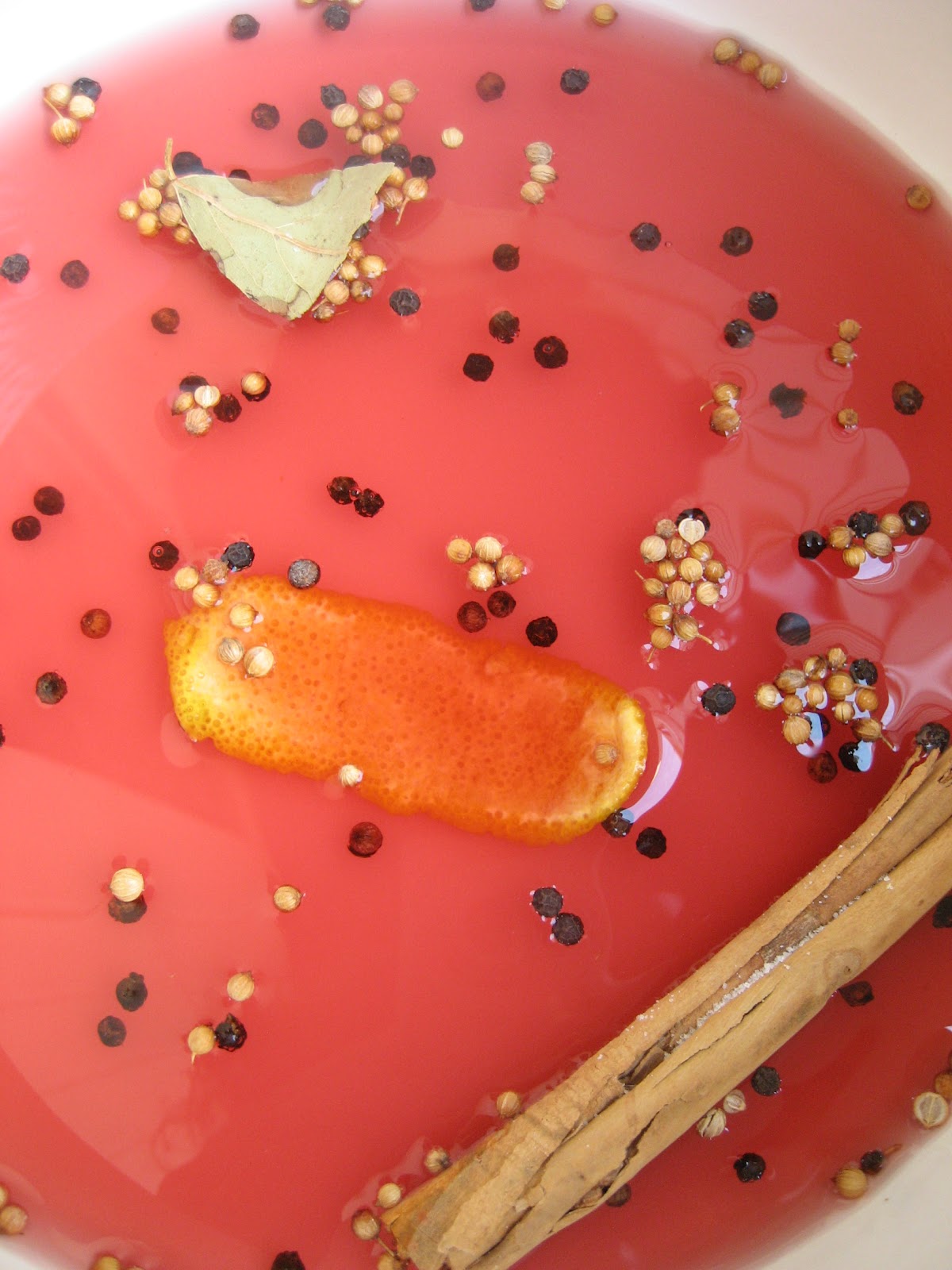
2 large strips of orange peel, removed with a vegetable peeler
1 tablespoon whole black peppercorns
2 cinnamon sticks
1 tablespoon coriander seeds
1 bay leaf

After washing your cherries, prick each one a few times with a fork and place in a large bowl.

Mix the rest of the ingredients in a large non-reactive pot and bring to a boil over medium heat. Reduce to a simmer and cook for 10 minutes.

Remove from heat and let cool for 10 minutes.

Place cherries in a quart-sized jar, spoon in the orange peel, cinnamon sticks and spices, and then cover completely with the pickling liquid.

Store in the fridge for 1 month, but wait at least 24 hours before eating so there's time for the flavors to infuse.


Sweet & Sour Manhattans
This cocktail is best made one at a time.

2 ounces good quality bourbon
½ ounce sweet vermouth
2 dashes of Angostura bitters
½ ounce of pickled cherry brine
1 pickled cherry

Pour the liquid ingredients into a cocktail shaker filled with ice. Shake well and strain into a chilled cocktail glass. Garnish with a pickled cherry. Lean back and enjoy.

These cocktail cherries also make an excellent cocktail garnish.

Pickled Cherries and Sweet & Sour Manhattans on Punk Domestics

Saturday, July 21, 2012

Swapper Profile: Lea Rude + Candied Citrus Peel and Citrus and Stone Fruit Jam Recipes

It has been way too long since we've had a swapper profile, so it is with considerable fanfare {cue drums and crowd cheers} that I introduce Lea Rude. When Lea walked into the swap a few months ago, we immediately recognized each other. After some to-and-fro we narrowed it down to UC Santa Cruz days, but not the specifics. We gave up on trying to place our common past, because really it doesn't matter at all, and just feels nice that we've reconnected now through food swapping. I especially appreciated her clever name and packaging play on the famed Lea & Perrins Worcestershire Sauce with her assorted lemon, orange and aromatic bitters at the April swap. And though I missed out on those sadly (consider this my unapologetically overt plea for her to make more), I scored some of her Vin d'Orange that was an especially big hit one late night with a gang of my girlfriends. And, she's included not one, but two recipes for your lip-smacking enjoyment. Bonus!

Lea shows off a watermelon from her CSA
Name: Lea Rude

Home / Hometown Swap: El Cerrito, San Francisco
           
Profession: Librarian

How did you first get involved in food swapping? How long ago?

I first heard about SF Swappers from my friend, Christina Moretta, and it sounded like it was right up my alley. We had been doing a bit of casual home-made food trading over the past couple of years and the swap sounded like a fun way to take it further. I have been to the last two swaps.

What did you make for the last food swap and what inspired your choice?

I made Candied Citrus Peel and Pickled Red Onions. I had been curious about making candied citrus peel since earlier this year when a friend served some home-made candied Meyer lemon peel at a party (along with home-made limoncello!)  I have a steady supply of Meyer lemons from our backyard tree and I had some ruby red grapefruits and oranges on hand, so it seemed like the time to do it. The red onions came in my CSA. I’m not a big fan of raw onion so I decided to pickle them.

Pickled Red Onions for the swap

What’s your favorite thing about swapping?

I really like the swap itself. The social aspect is awesome and totally unique. I love talking to new people and getting inspired by what everyone makes. It is a great way to get ideas for new ways to cook. I love the potluck aspect and all of the tasting, too. I go home stuffed and pumped up!

Who or what most influences your cooking?

My mom is definitely the biggest influence and inspiration for me in the kitchen. She is an amazing cook – she can make a tasty and satisfying meal from whatever happens to be in the pantry, but she can also go home after a meal in a great restaurant and recreate her favorite dish. Whenever I make something new or just really good I get on the phone and tell my Mom all about it, and she does the same with me - she is always turning me on to new ingredients and new approaches to cooking.

What’s your favorite kitchen tool?

I am currently working out how I can make space for a permanent spot on the counter-top for my blender. I have been using it a lot more since I started making salsas and it keeps getting pulled out lately to make aguas frescas and smoothies.


Booty from Lea's CSA box


Your current flavor or ingredient obsession?

The ingredients of my CSA box. We started getting a box from Terra Firma Farms in January and it has had a huge influence on my cooking. My approach to cooking in general has always been to use what is on hand but this has taken it to another level. Every week I have to figure out what to do with the bounty of produce that comes in, sometimes including things I have never cooked before. It is so much fun!

Garlic Scapes
Biggest food surprise?

A recent surprise was garlic scapes. I just caught word of them a couple months ago on some canning blogs, but I had never seen them before. I took a trip to Vermont last month and saw them everywhere! Farmers markets, farmers stands, and in my friends’ CSA. At the CSA farm they had giant tubs of extra garlic scapes, so we made grilled scapes and garlic scape pesto. They taste great but I think the most surprising and delightful thing is their looks. They are so silly!

If the Rapture came tomorrow, what would your last meal on earth be?

I am on a mostly gluten-free diet, so if an asteroid were going to collide with the earth tomorrow I would spend the day eating things on bread. Good butter, triple-cream brie, homemade pesto, and all the homemade preserves in the house on sweet baguette. Plus steamed artichokes and Dungeness crab with butter and garlic.

When I'm not in the kitchen… I'm sewing, reading or walking the dog.

Favorite local food experience:

Backyard BBQs with friends year round, fancy dinner at Camino in Oakland, casual lunch at Tacubaya in Berkeley.

Recipes by Lea:

Candied Citrus Peel
Candied Citrus Peel

When I decide to make the candied citrus I trolled around online and read some recipes in cookbooks. I did what worked with my schedule and used the techniques that sounded right.

Remove the peel in large strips from 2 grapefruits, 3 oranges and 6-7 lemons, about 5 lbs. of fruit. Large strips are best. Little pieces fall apart and get lost in the syrup.

Scrape or slice off any pith that is left on the peel, but keep the white part. That gives it heft and the bitterness and toughness is simmered out in the next step.

Cover the peels in cold water and bring to a boil, then lower the heat and simmer for 10 minutes. Drain, and repeat once, then repeat again but simmer for 15-30 minutes, depending on how much time you have. Drain peels.

Combine 5 cups of sugar and 5 cups of water, bring to a boil simmer for 10 to 15 minutes, then add the peel and simmer for 45 minutes. Remove from the heat and let cool to touch.

Remove the peels from the syrup and place on wire racks placed over cookie sheets or platters. Try to keep the strips from touching each other. Let dry for 24 hours (a cold oven is a good place to keep them out-of-the way and dust-free).

Put ½ cup sugar or superfine sugar in a bowl (I actually pulsed regular sugar in a food processor to make it finer). Roll the peels in the sugar to coat, then let dry for another hour. These should keep for a couple of months at room temp in airtight containers.

Candied Citrus Peel packages for the June swap


Citrus and Stone Fruit Jam

I had about 3 cups of syrup left over from making the peels and I figured it would be a good base for a small batch of jam. I had cherries, apricots and a peach from the CSA, so I made this jam. It is my favorite jam ever! You can use any combo of fruit, but definitely include the lemon – it makes a perfect sour, chewy addition to the sweet jam.

Syrup left over from making candied citrus peel (above)
3 apricots
1 peach
a handful of cherries, pitted
1 Meyer lemon, quartered, seeds removed, sliced thin (keep the skin on)

Cook all ingredients for about 20 minutes. Put in a jar and refrigerate. Eat! Yum!

Tuesday, July 17, 2012

Cooking The Breakfast Book, Chapter 2: Fruit Syrup French Toast

Since the last Cooking The Breakfast Book installment (which was indeed, the first), a dash of kismet has been added into the mix. Marion Cunningham, author and home cooking advocate, passed away at the age of 90. Reading about her in a great article in the NY Times only made me admire her more, and I particularly loved this bit: "She loved to go to the supermarket and peer into the baskets of startled strangers, whom she would then interview about their cooking skills. Indeed, she made it her life’s work to champion home cooking and preserve the family supper table." This image brings a wide smile to my face and laughter to my heart. Not so different from how I have begun to feel while reading her book and cooking and sharing her food, actually. So onward we go, offering our humble cooking project as an ode to a food enthusiast of the highest order.


Pain perdu, saved!

Chapter 2: Toasts, French Toasts and Breakfast Sandwiches

The introduction for this recipe taught me something new. With a classically French sense of poetry, in France french toast is called pain perdu (lost bread) as it is considered a way to use up day-old or hard bread.


As a measure of my appreciation of the name — and the sentiment of reclaiming food that would otherwise go to waste — I decided to really put the old bread theory to the test by using the remains of a loaf of Hideaway Bakery's seeded wheat sourdough that was a good five or six days past fresh. After sawing through the tough outer crust I was having my doubts, but the inside of the bread was still quite soft, and Ms. Cunningham does recommend using a dense, homemade style bread for french toast, so I stuck to the plan and was very pleasantly surprised.

The moisture from the egg and milk, plus the layer of fruit syrup flavor really makes this french toast recipe a standout. Even with bread that is on its very last legs!

I did wonder if blueberry syrup was a good choice given the color it would impart (see below), but despite the unappetizing hue while dipping, it thankfully did not present itself in the finished dish.

Though not called for in the original recipe, I sprinkled cinnamon and nutmeg on each side as the toast cooked, because that's part and parcel of french toast in my book. Feel free to leave out or substitute with cardamom or other favorite spices.


Fruit Syrup French Toast
Adapted from The Breakfast Book by Marion Cunningham
Serves 4

3 eggs
1/2 cup milk, light cream or heavy cream
1/4 cup fruit syrup
Salt to taste
6 slices bread (preferably a dense homemade type; typically white, but try rye or whole wheat, too)
4 tablespoons (1/2 stick) butter
Cinnamon and nutmeg, for sprinkling

Combine the eggs, milk, syrup and salt in a medium bowl with a fork until well mixed. Strain through a sieve into a shallow bowl large enough to easily dip your slices of bread.

Give each side a minute or more (depending on density of your bread) to soak up the egg mixture completely. When done, place each battered slice on a sheet of wax paper.

Melt half the butter in a pan large enough to cook three slices of bread at the same time, and cook them on medium heat until lightly browned on each side, turning once. Sprinkle cinnamon and nutmeg on each side as you cook.

Keep the cooked slices warm in a 250° oven while preparing the last three slices. Serve warm with your favorite french toast toppings. I suggest a dab of butter, fresh fruit and more fruit or maple syrup.

Recipe for Blueberry-Basil Syrup
Makes approximately 3/4 cup

1 cup fresh blueberries
1/2 cup water
2 pieces of lemon peel
3 tablespoons sugar
The top portion of 2 sprigs of basil (or 4 medium to large leaves)

After washing the blueberries, put them in a small non-reactive pan and add half the water. Use a sharp knife to remove two thin pieces of peel from a lemon, making sure to include as little of the white pith as possible. Smash the berries with a potato masher to release the juice, while bringing to a boil over medium heat. After adding the lemon peel, lower the heat and let simmer for 5 minutes.

Strain through a fine sieve and reserve the berries to mix into plain yogurt or add to a smoothie later. Rinse the pan and add the rest of the water and the sugar, stirring as you bring to a boil. Once sugar is dissolved, add the blueberry syrup and the basil springs and simmer for another 4 to 5 minutes. Cook a little longer if you prefer a thicker syrup, but avoid having it thicken too much or it will set into a jelly.

Remove basil sprigs and let syrup cool to room temperature before using. Store in fridge.


I'll be back with another chapter in two weeks, but in the meantime please don't forget to visit the pages of my five fellow food bloggers to see what they picked and prepared from Chapter 2: